

Biodiesel - A Viable Renewable Energy Resource
December 25, 2022
4 min
The traditional craft of making joint-less green glass bangles is prevalent in the Unch village of the Nadbai block near Bharatpur, Rajasthan. RuTAG IIT Delhi interacted with the artisans engaged in this craft with the help of the LUPIN foundation and identified problems with their furnaces, seating posture during work, and the tools they use. In this paper, the experience of developing solutions to these three problems has been discussed. A new furnace with commercial ceramic fiber insulation and a chimney-damper arrangement has solved the problem of hot and polluted working space and has also resulted in saving over 70% of the fuel they use in the furnace. Alternative seating arrangements proposed for the artisans were well-received by them. Modifications to their working tools also were appreciated by the artisans during the trials conducted. The furnace is in operation in the village. The other solutions need active promotion in the village before their effective adoption by artisans.
The bangle-making process involves heating glass to a semi-molten (jelly-like) state in a furnace, drawing desired quantities of glass from the melting tray and forming it into the desired shape and size by hand tools. The furnace is fired using cheaply available biomass like sawdust, husk, and agricultural residues as fuel.
A traditional furnace used in the area for making bangles is shown in Figure 1. It has a diameter of about 1 m with 16 small window-like openings to enable 15 artisans to work simultaneously on one furnace. The sixteenth opening, which is larger than the other windows, is used for the manual feeding of loose biomass into the furnace (Fig.2). The temperature inside the furnace is around 12000 C to 13000 C. Temperature of semi-molten glass kept inside the furnace is around 11000 C. The raw glass is melted in small earthen trays kept in the furnace one near every working window (Fig.3). A desired amount of the semi-molten glass is drawn from the tray kept inside the furnace using the tip of a long pointed iron rod. A small hammering tool is used to tap this rod to create a small hole in the collected glass blob. Then the iron rod is shaken such that this hole enlarges and the glass takes the shape of a small ring. This small ring is then transferred to the sizing mold (locally known as kalbhoot), which is rotated manually.
As the spinning continues, the red-hot loop of semi-molten glass is pushed back to expand along the cone to a ring of the desired diameter. This process takes place within 5-10 seconds, during which the glass cools down and solidifies, and a bangle is ready.
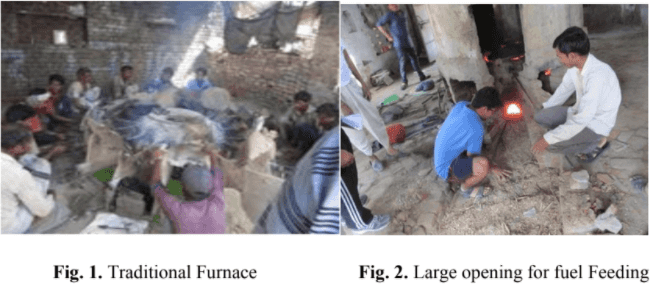
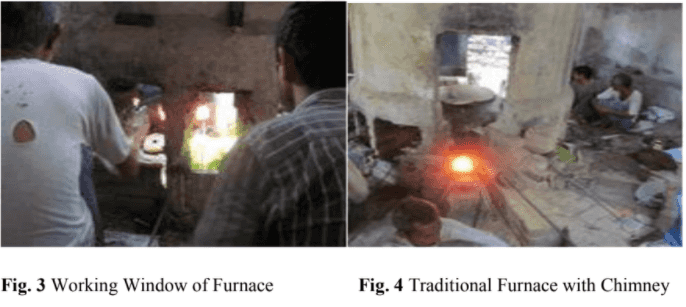
The artisans perceived several problems in using this process. These problems were categorized into three parts: problems related to
These are further discussed in detail below.
Problems related to the furnace
Problems of uncomfortable ergonomic position:
Due to the various problems faced by them, the artisans had to take frequent breaks leading to a reduction in productivity. Further work on development and modification was done by technicians of Rural Technology Development and Delivery. For prototype and Demo of newer and better-developed designs please contact RUTAG, IIT Delhi.
Quick Links
Legal Stuff